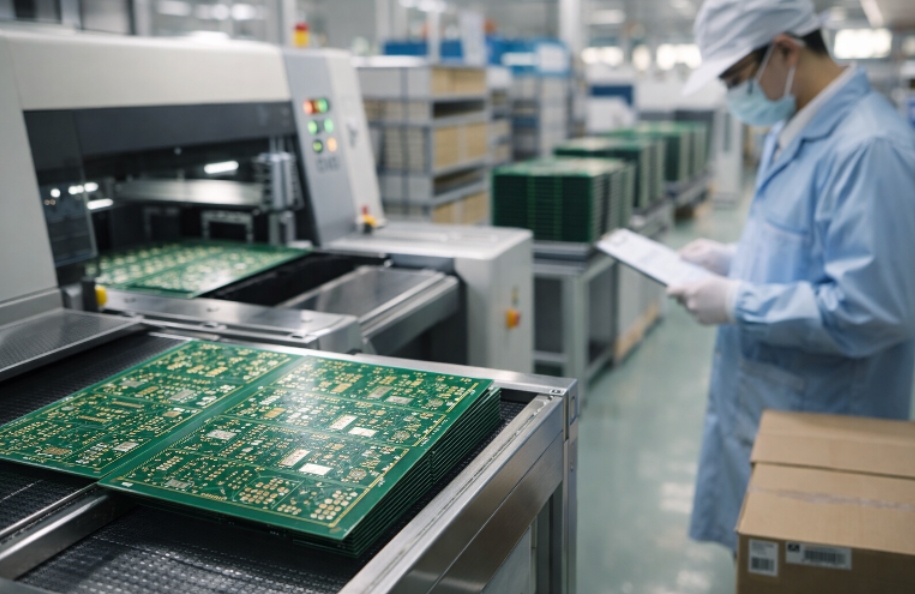

When you speak to hardware founders, OEM purchasing teams, or even university design teams that are making prototypes, you will find the same gravitation: when the design is where you want it to be, on a board, many design teams will find a pcb manufacturer in china. In the last ten years of assisting brands in planning content and supplier shortlists, I have observed the reasons why such a decision continues to emerge. It’s not only about price. It is also about speed, maturity of the process, and being able to scale up to full production with one prototype and not have to change your entire workflow.
This guide clarifies why the real reasons are that brands prefer China to manufacture PCBs, what they should compare when selecting a factory, and where a quick-turn supplier such as FastTurn PCB can be applied in situations when time is of the essence.
The China Advantage: Scale, Speed, and Supply Chain Density
The PCB ecosystem of China is density-based. The Western manufacturers have the suppliers that supply to a PCB factory nearby in most manufacturing centres such as the laminate supplier, drill shop, stencil shop, surface finish supplier, and logistics services.
It is important since a printed circuit board is not a single thing. It is a regulated process: imaging, etching, drilling, plating, solder mask, silkscreen, surface finish, electrical testing, and final inspection.
As these steps are backed by a well-developed local supply chain, the factories can be changed quicker and more regularly. In the case of brands, it can mean reduced lead times on prototypes and reduced delays due to delays in waiting on external suppliers.
This is one reason why quick-turn services are prevalent in China, particularly to 2-layer and 4-layer boards, and to an ever-growing extent, HDI and smaller design.
Cost Is Real, but It’s Not the Only Reason
Yes, cost is a driver. Competitive pricing can be easily provided in China due to volume buying, labor productivity, and an established manufacturing sector. However, in reality, smart teams do not select a factory using price as a criterion.
The actual cost is cost-per-successful-build. A cheap quote is not useful when the boards are late, cannot pass electrical tests, or have variable impedance.
An improved factory will minimize the re-spins, minimize debugging time, and help get your product to market earlier. As far as calculating total project cost is concerned, the stability and quality control can be more significant than saving a few cents per board.
How Brands Compare to Select a PCB Manufacturer in China
These are the criteria that tend to cause the difference between a supplier who is good enough and one that becomes a long-term manufacturing partner when it comes to assessing a pcb manufacturer in china.
Quality Control and Testing Discipline
Different test standards and disciplines in quality control are practiced in the organization.
Find good testing practices, not assertions. It is your desire to have explicit electrical test coverage, automated optical inspection (AOI), and documented process control.
Numerous established factories do meet well-known industry standards such as IPC, and will indicate compliance alternatives of RoHS and others. Inquire about their approach to traceability and how they react to the identification of a defect.
Don’t Overbuy, Don’t Underbuy Capability Match
Other teams select a large factory that they can get and reason that large is big. However, you should match capability to what you are actually building.
When you are making a basic controller board, you might not require an extreme capability of HDI. When constructing a small RF board, control of impedances, stack-up knowledge, and fineness of surface finish are essential.
Ordinary areas of capability to verify are layer count, minimal trace/space, drill sizes, type of via, controlled impedance, options of rigid-flex, and finishes such as ENIG or lead-free HASL.
Communication and Engineering Support
Communication and Engineering Support This also includes the engineering support and communication with the customer and the engineer.
This is where the projects usually succeed or fail. When the feedback of DFM is unclear, or questions require days to be answered, you will experience it directly in your timeline.
The most effective partners provide timely, feasible feedback on the risk of annular rings, solder mask slivers, and via-in-pad options, and stack-up decisions. Good communication is able to avoid a re-spin before it occurs.
Where FastTurn PCB Fits: When Time Matters as Much as Specs
A high number of the buyers seek a pcb manufacturer in china owing to the fact that they require quick turnaround without compromising on the reliability of the baseline. That is where an expedited turn turnkey partner like FastTurn PCB can fit with strength, particularly when you are transitioning out of prototype to pilot production.
It is hard to find a single major error when it comes to delays in fast-moving projects. They are the results of minor irritations: confusing file validation, time-wasting inquiries, lack of confirmation, and length of queues. A high turnover workflow is set to minimise those frictions.
The FastTurn-style services would generally be most useful in cases where one or more of the following are required: verification of prototype in a short timeframe, rapidly checking a prototype after a preliminary test, or a quick bridge before scaling a design.
With the startup or being a student team, this rate can mean the difference between us launching this quarter and us not making it.
China vs Other Regions: A Practical Comparison
When comparing China to other manufacturing regions, it is often a matter of the lead time, unit cost, and the flexibility of the supply chain.
China has a tendency of winning in quick turn capacity, particularly in typical stack-ups and typical materials. It is also scalable, which may be strong, as numerous factories accommodate prototypes as well as volume production.
Other regions can be better in local communication, shipping distance, or limited requirements, but they might be slow or more costly in quick iteration.
One simple question that can be useful to make the decision is to determine whether you are maximizing speed of learning or speed of shipping. In early development, quickness of getting things is normally the victor in learning. When the design is stable, then can be optimized to long term economics of production.
What to Do to Get Better Results from Any PCB Order
No matter how good a pcb manufacturer in china is, he would not save a botched handoff. In the case of clean inputs, there are clean outputs.
Have Gerbers, drill files, stack-up notes, fabrication drawing, and others in order before you commit an order. Check the board thickness, weight of copper, finish, solder mask color, and controlled impedance targets.
When there is assembly, have your pick-and-place files and BOM aligned and updated.
My experience indicates that teams who consider the handoff a manufacturing package receive quicker quotes, less questions, and less surprises.
Conclusion: The True Story Behind Brands Choosing China
When the quality is managed properly, PCBs are produced by brands in China due to the fact that the ecosystem enables rapid iteration, easy scale, and cost competition.
The most intelligent purchasers compare the discipline of testing, fit of capability, and communication rather than quotes only.
In case speed is what you need and you do not want chaos, consider a pcb manufacturer in china constructed to operate in quick-turn cycles like FastTurn PCB and get your idea to working hardware in fewer delays and less messy than before.
FAQs
Should we consider that a new product can be introduced using a pcb maker in china?
Yes, provided that you make a selection of suppliers as a quality decision and not price decision. Attend testing, speed of communication, traceability, and clarity of the process. A formal first level and set specifications is a clever manner of certifying a supplier.
What does fast-turn entail PCB manufacturing?
The term fast-turn tends to imply that the prototype or small-batch boards have shorter lead times, backed by expedited engineering testing and priority production lines. It comes in particularly handy when you know that there will be revisions and you need boards in a hurry to keep the project on track.
When is it possible that I should use FastTurn PCB rather than a general factory?
Select a fast-turn vendor such as FastTurn PCB when you are on a tight schedule, design is still under development, or you require prototype-to-pilot pace. On large-unit cost optimization and have a stable design, a high-volume factory might be a better fit.
What do I do to prevent quality problems when outsourcing PCBs?
Begin with a controlled test order, verify written materials and finishes, and enquire what inspection and electrical testing are to be made. Make clean and consistent files and answer DFM questions fast to ensure that one does not guess problems.